


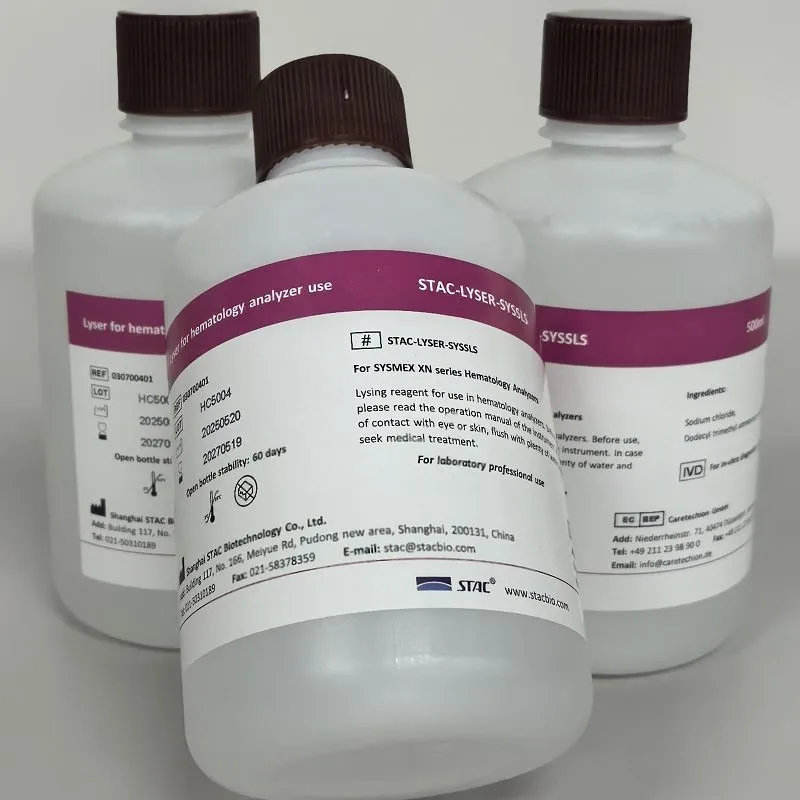
Reticulocyte Hematology Control provides tri-level quality management material specifically formulated to monitor the precision and accuracy of automated hematology analyzers performing reticulocyte parameters.
What Are Hematology Controls / Calibrators?
Hematology controls and calibrators are biological reference materials required for laboratory analytical verification.
Controls are stabilized whole-blood preparations with designated target ranges used in daily routines to evaluate system performance, monitor analytical drift, and verify continuous precision.
Calibrators are high-precision standards with assigned reference values, applied periodically to set or adjust the mathematical response curves of hematology instruments.
Role in Hematology Quality Control
Reticulocyte parameters require dedicated control materials due to the unique structural and RNA staining characteristics of immature erythrocytes.
Routine Precision Tracking: Detects analytical variations and optical performance shifts prior to patient sample testing.
Statistical Process Control: Supports Levey-Jennings charting and multi-rule quality control evaluations across operational shifts.
System Compliance: Delivers baseline analytical verification data for international laboratory accreditation standards.
Control Levels / Application
Level 1 (Low): Contains low reticulocyte concentrations to verify measurement sensitivity near lower detection limits, supporting evaluations of bone marrow suppression.
Level 2 (Normal): Mirrors physiological reference ranges to validate routine clinical screening.
Level 3 (High): Reaches elevated reticulocyte concentrations to confirm analytical linearity across upper measurement ranges.
Control vs. Calibrator
|
Characteristic |
Control |
Calibrator |
|
Primary Function |
Routine precision tracking |
Parameter scaling and alignment |
|
Testing Frequency |
Daily or per operating shift |
Periodic or after maintenance |
|
Assigned Value |
Target range (Mean $\pm 2\text{SD}$) |
Fixed target value |
|
Material Form |
Multi-level (Low, Normal, High) |
Single baseline level |
Compatible Hematology Analyzers
Formulated for multi-platform compatibility, this material operates across multi-angle laser scatter and fluorescence flow cytometry detection channels equipped for reticulocyte analysis.
Assigned Values / Parameters
Target ranges represent mean assay values and standard deviation limits (± 2SD) derived from multiple reference runs.
|
Parameter |
Unit |
Level 1 (Low) Range |
Level 2 (Normal) Range |
Level 3 (High) Range |
|
RET% (Reticulocyte Percentage) |
% |
0.30 – 0.80 |
1.20 – 2.20 |
4.50 – 7.50 |
|
RET# (Absolute Reticulocyte Count) |
10¹²/L |
0.010 – 0.035 |
0.050 – 0.090 |
0.200 – 0.350 |
|
RBC (Red Blood Cell Count) |
10¹²/L |
1.80 – 2.40 |
3.80 – 4.40 |
4.80 – 5.40 |
|
HCT (Hematocrit) |
% |
15.0 – 21.0 |
33.0 – 39.0 |
42.0 – 48.0 |
Product Specifications
|
Item |
Specification |
|
Physical State |
Liquid whole-blood cell suspension |
|
Vial Volume |
3.0 mL / 1.0 mL |
|
Packaging Option |
Tri-level combination pack or single-level pack |
|
Reported Parameters |
RET%, RET#, RBC, HCT |
|
Assigned Value Sheet |
Enclosed per production lot |
|
Manufacturing Environment |
ISO 13485 certified facility |
Storage & Stability
Unopened Shelf Life: 75 days stored upright at 2°C – 8°C.
Open-Vial Stability: 14 days when sampled under aseptic conditions and returned to 2°C – 8°C immediately after use.
Temperature Control: Do not freeze. Store protected from light.
Quality Assurance
Donor Screening: Human donor source materials test negative for HBsAg, anti-HCV, and anti-HIV 1/2.
Lot-to-Lot Uniformity: Standardized preparation processes ensure consistent cell distribution between batches.
Cold Chain Shipping: Insulated thermal packaging maintains internal temperatures within 2°C – 8°C during transit.
FAQ
Q: How should the material be prepared prior to sampling?
A: Remove the vial from cold storage and allow it to reach room temperature (15°C - 30°C) for 15 minutes. Invert the vial gently 8 to 10 times until red cells are completely resuspended. Avoid aggressive shaking to prevent cellular damage or bubble generation.
Q: What factors cause values to fall outside the target range?
A: Out-of-range recovery often results from incomplete mixing, improper refrigeration, contamination, or instrument optical flow cell drift.
Q: Can this material be used to calibrate hematology instruments?
A: No. Quality control materials serve to verify analytical precision within a range, whereas calibration requires specific calibrators with single-value assignments.
Q: How are lot-specific target values accessed?
A: Each package includes a lot-specific assay sheet specifying expected mean values and range limits for compatible detection platforms.
Q: How is temperature maintained during long-distance transportation?
A: Shipments are packed in thermal containers with refrigerant packs configured to maintain an internal ambient range of 2°C to 8°C throughout transit.
Hot Tags: reticulocyte hematology control, China reticulocyte hematology control manufacturers, suppliers


