


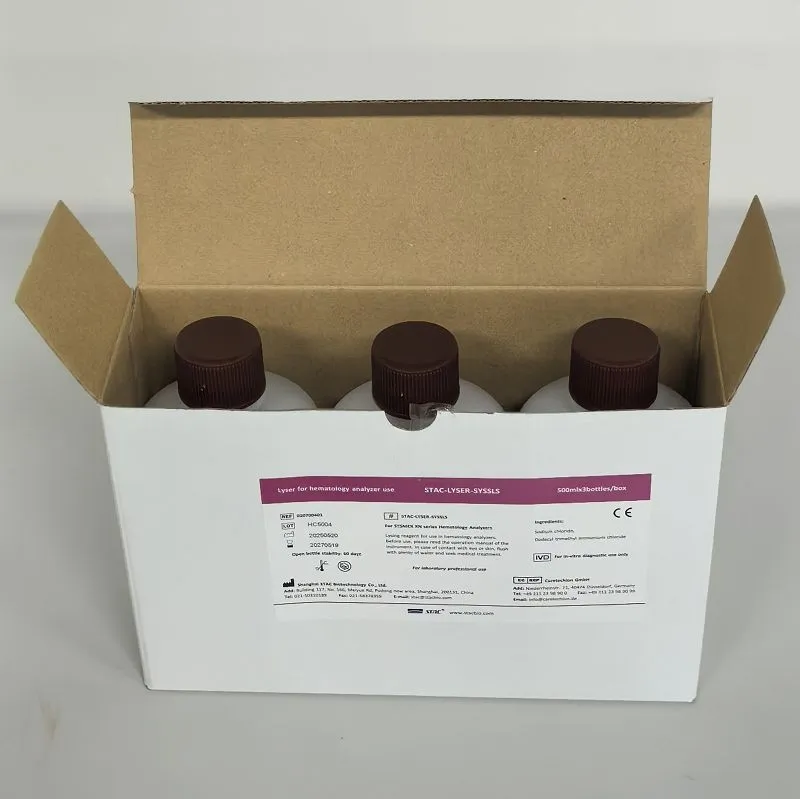
Tri-Level Hematology Analyzer Control contains stabilized human and mammalian cellular components suspended in a buffered fluid matrix. Formulated in three distinct concentration levels-Low, Normal, and High-this liquid reference material verifies measurement precision, tracks calibration stability, and flags systemic operational errors across automated blood cell counters.
What Are Hematology Controls / Calibrators?
Quality management in clinical hematology relies on two distinct reference materials:
Controls: Daily testing samples with known mean values and range limits. They monitor internal system precision and operational consistency over time without modifying instrument system settings.
Calibrators: Dedicated reference standards assigned specific primary values. They adjust physical measurement factors and conversion coefficients to ensure output accuracy against reference methods.
Role in Hematology Quality Control
Routine operation of a three-level control matrix covers critical operational requirements:
Analytical Decision Boundaries: Assesses system performance at pathological extremes-such as severe cytopenia and marked leukocytosis-alongside normal clinical levels.
Error Detection: Identifies fluidic micro-blockages, reagent oxidation, optical laser degradation, and baseline electronic noise before clinical reporting.
Process Compliance: Fulfills internal quality assurance procedures requiring regular multi-level monitoring across each operational shift.
Control Levels / Application
Level 1 (Low)
Targeted at reduced cell concentrations. Tests measurement response near lower detection limits for leukopenia, anemia, and thrombocytopenia samples.
Level 2 (Normal)
Targeted at physiological ranges. Monitors standard operational performance during routine daily specimen runs.
Level 3 (High)
Targeted at elevated cell counts. Validates linearity and optical response during high-concentration scenarios such as leukocytosis or thrombocytosis.
Control vs. Calibrator
|
Characteristic |
Hematology Control |
Hematology Calibrator |
|
Purpose |
Monitors daily system precision and stability |
Adjusts instrument accuracy parameters |
|
Frequency |
Analyzed daily or per work shift |
Processed after calibration maintenance or shift drift |
|
Data Format |
Target mean paired with an upper/lower range |
Single fixed target value |
|
Action on Output |
Flags unexpected analytical variations |
Re-calculates and overwrites system gain factors |
Compatible Hematology Analyzers
Formulated for physical compatibility across cell counting platforms utilizing:
- Electrical Impedance Measurement
- Optical Laser Scattering
- Photometric Hemoglobin Determination
Assigned Values / Parameters
|
Parameter |
Unit |
Low (Level 1) |
Normal (Level 2) |
High (Level 3) |
|
WBC |
10⁹/L |
2.10 ± 0.40 |
7.20 ± 1.00 |
18.50 ± 2.50 |
|
RBC |
10¹²/L |
2.30 ± 0.20 |
4.40 ± 0.30 |
5.30 ± 0.40 |
|
HGB |
g/dL |
6.2 ± 0.5 |
13.5 ± 0.6 |
18.0 ± 0.8 |
|
HCT |
% |
18.5 ± 2.0 |
39.0 ± 3.0 |
51.0 ± 4.0 |
|
PLT |
10⁹/L |
65 ± 20 |
210 ± 40 |
480 ± 60 |
Product Specifications
|
Property |
Technical Specification |
|
Physical Form |
Ready-to-use suspended cell suspension |
|
Matrix |
Human and mammalian blood elements |
|
Packaging |
12 × 3.0 mL vials per box (4 × Low, 4 × Normal, 4 × High) |
|
Reconstitution |
None required |
|
Quality Standard |
ISO 13485 manufacturing environment |
Storage & Stability
Unopened Storage: 2°C to 8°C. Protect from direct light. Do not freeze.
Closed-Vial Shelf Life: 105 days from production date when maintained continuously at 2°C to 8°C.
Open-Vial Stability: 14 days or 14 sampling events when stored at 2°C to 8°C immediately after sampling.
Transit Conditions: Thermal packaging with phase-change cold packs maintaining internal cold-chain temperatures.
Quality Assurance
Traceability: Values calibrated against reference determination methods.
Lot Consistency: Inter-vial coefficient of variation maintained within CV < 1.5%.
Batch Release: Analytical verification on multiple testing systems prior to lot release.
Data Documentation: Lot-specific assignment tables supplied with each product kit.
FAQ
Q: How should vials be mixed before sampling?
A: Allow the vial to reach room temperature ($15^\circ\text{C}$–$30^\circ\text{C}$) for 15 minutes. Roll the vial horizontally between palms 8–10 times, then gently invert end-over-end 8–10 times. Avoid shaking to prevent air entrainment.
Q: Where are lot-specific assay values located?
A: Assay sheets specifying parameter targets and control ranges are packed inside each package. Digital files are accessible via lot number verification.
Q: What steps are required if recovery falls outside target ranges?
A: Verify mixing procedures, room temperature, and vial expiration. Re-sample the vial. If values remain off-target, check fluidic tubing for bubbles, inspect reagent levels, and test a fresh unopened control vial.
Q: What are the disposal requirements for used vials?
A: Handle opened vials as biological specimens. Dispose of liquid remnants and packaging according to standard laboratory biohazard disposal protocols.
Q: How is cold-chain integrity maintained during international transport?
A: Shipments use insulated container configurations fitted with cold-storage packs, preserving the required 2°C–8°C temperature boundary throughout air and ocean cargo routes
Hot Tags: tri-level hematology analyzer control, China tri-level hematology analyzer control manufacturers, suppliers


